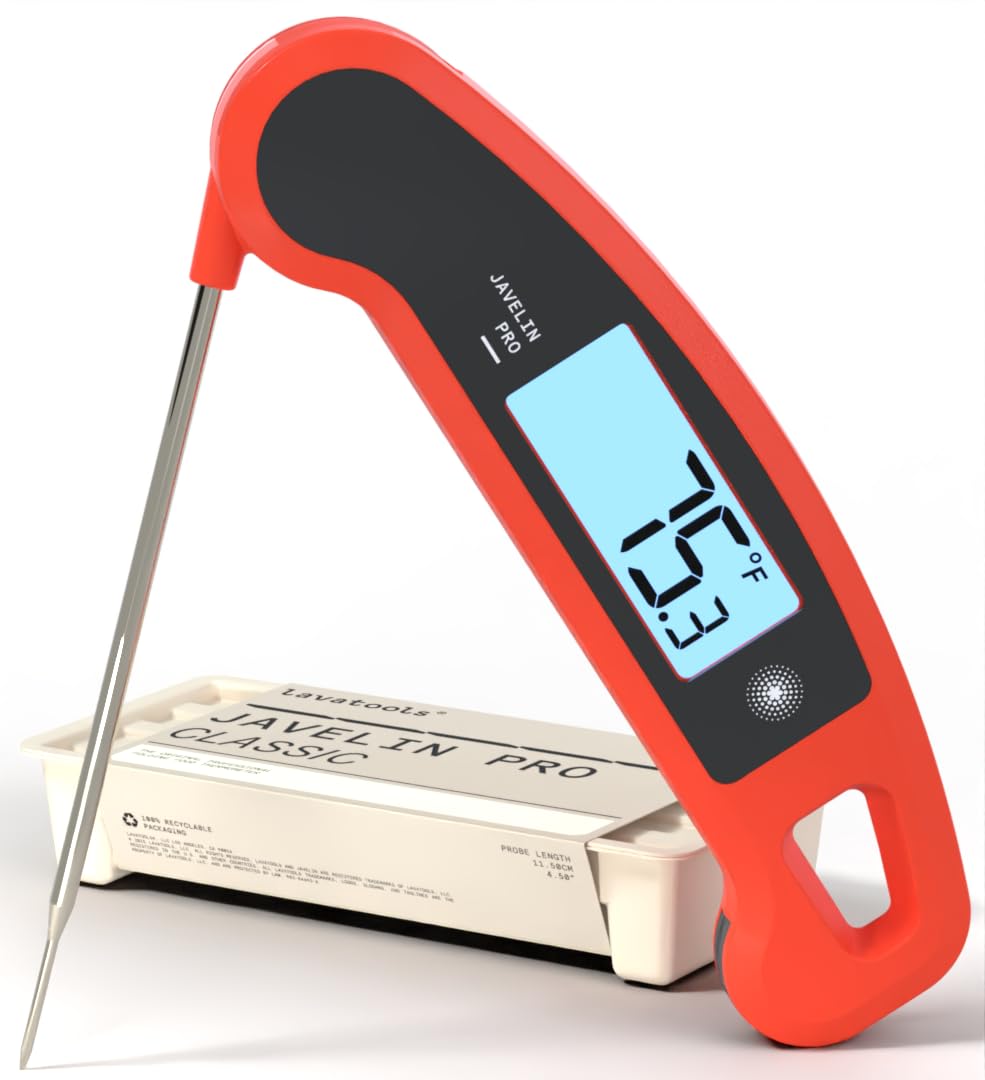
We compared manufacturer specs, manuals and warranty terms. We have not hands-on tested these products yet. How we research
We may earn a commission when you buy through links on this page. As an Amazon Associate I earn from qualifying purchases. How we make money
An instant-read thermometer is the cheapest upgrade that makes grilling safer, because color and grill marks do not tell you meat is done. The specs that separate them are read speed, stated accuracy, whether you can calibrate it, and how well it survives a wet, greasy grill-side life. This guide is for every cook who does not own one yet, or owns a slow one. FSIS says most food thermometers are accurate within 2 to 4°F (USDA FSIS), so the features that let you check and re-check the reading matter as much as the maker's accuracy figure.
We compared 6 meat thermometers and picked 6.
Our picks at a glance
1
Best overallThermoWorks Thermapen ONEThermoWorks rates it at one-second readings and ±0.5°F accuracy, with an auto-rotating backlit display and a waterproof body.
Currently unavailable on Amazon
2
★ Start hereBest budgetTempPro (ThermoPro) TempSwift TP19HA low-cost instant-read with a backlit, auto-rotating display, a fold-away probe and a magnet for the grill hood.
$12.59Price as of Nov 25, 2026, 4:57 AM ET. Details
Best app-connectedGovee Bluetooth Meat ThermometerA leave-in Bluetooth thermometer that alerts your phone at your target temperature, with USDA doneness temps built into the app.
$18.99Price as of Nov 25, 2026, 7:04 PM ET. Details
Read speed and accuracy first, then the features that make it pleasant to use. For long smokes, a leave-in wireless thermometer is the better tool.
Read speed
USDA FSIS lists typical read times by type: thermocouples 2 to 5 seconds, thermistors about 10 seconds, instant-read dial thermometers 15 to 20 seconds (USDA FSIS). Compare the maker's stated read time in the table, and remember it is a lab figure, not a promise in every cut. Speed matters most on thin cuts such as burgers and chops, where the sensor sits close to the surface and a slow probe keeps the lid open longer.
Stated accuracy
FSIS says most food thermometers are accurate within 2 to 4°F (USDA FSIS). Makers list their own accuracy, often for a specific temperature band; read the fine print in the listing or manual.
Calibration
FSIS notes that thermocouples and wireless models can be calibrated, and some thermistor and dial models can; oven-cord and fork types cannot (USDA FSIS). Our guide on how to use and calibrate a meat thermometer walks through the ice-water check.
Probe length and thickness
FSIS gives minimum insertion depths by type: about 1/4 inch for a thermocouple and 1/2 inch for a thermistor (USDA FSIS). A thin tip makes it easier to hit the center of burgers and chops from the side. For whole poultry, FSIS says to check the innermost thigh, the innermost wing and the thickest part of the breast (USDA FSIS), which a longer probe makes easier.
Water resistance
Check the listed IP rating: the higher the second digit, the more water it is rated for. Read the manual for cleaning instructions before you put it under the tap. An IP rating describes the housing as the maker rates it; follow the cleaning section of the manual for the probe itself.
Display readability
Look for a backlit display, large digits and a screen that rotates when you hold it at an angle. Check what battery it uses and whether it switches off by itself.
Tips for using your meat thermometer
Check it in ice water: the stem at least 2 inches into stirred ice water for 30 seconds should read 32°F (USDA FSIS).
Insert into the thickest part, away from bone, fat and gristle; for thin patties and chops, go in from the side (USDA FSIS).
FSIS says a thermometer that can't be adjusted may need replacing once it stops reading right (USDA FSIS).
FSIS says bimetal dial thermometers aren't suitable for food under 3 inches thick (USDA FSIS), so look at the tip design before you buy one for patties.
FAQ
How do I calibrate a meat thermometer?
Stir ice into a glass of water, lower the stem at least 2 inches without touching the sides and wait 30 seconds; 32°F is the right reading. In boiling water at sea level, expect 212°F (USDA FSIS).
Where do I insert it?
Aim the tip at the thickest part and keep it off bone, fat and gristle. For a whole bird, take three readings: innermost thigh, innermost wing and the thickest part of the breast (USDA FSIS).
Which type reads fastest?
Speed depends on the sensor type: a thermocouple needs 2 to 5 seconds, a thermistor about 10 seconds and an instant-read dial 15 to 20 (USDA FSIS).
How accurate are they?
According to FSIS, most thermometers land within 2 to 4°F of the true temperature (USDA FSIS).